
Club History
1970 to 1979 - The Likely Lads of the Seventies
By Les Jordan
In most years of the Club’s history there have been numerous young men and women with a potential as competitive cyclists. The period of the seventies brought such a wealth of talent it is virtually impossible to record all of them and the success they brought to the Club. They were unique in two ways, one that they were very, young - most of them less than 15 when they first showed up. Secondly, they mainly lived and went to school in Hemel Hempstead. The impact they made on the Club and the scene of competitive cycling was quite dramatic.
Of the considerable number of boys and lesser number of girls just a few remain competing. Their dedication and determination was typified by Nigel Alexander a diminutive 13 year old who emigrated to New Zealand with his family in 1975. He never won a race but he equally never ceased trying and always finished quite exhausted.
The giants of the period were Ian, Derek and John.
Ian won numerous schoolboy races, the G.H.S. Time Trial Competition and several Track National Championships before riding both the Junior and Senior World Championships in the same year. He went on to win a bronze medal in the Montreal Olympics before turning professional in the Holdsworth colours.
Derek Hunt in 1970 was the smallest member of the Club. He won the Schoolboys Time Trial Championship before Ian came along and again after Ian became a Junior. Derek won the National Junior Pursuit Championship at Leicester following in Ian’s footsteps. Thereafter, the paths divided and Derek took himself to Holland, settled for a time, won a professional contract and then rode in the Skol six day race at Wembley before recently setting off for Australia.
John Dowling preferred to concentrate on road racing and time trials - an English Schools Cycling Association National Title - selection for the World Junior Championships and a place in the Milk Race were milestones in his progress at home. Invitations to ride in Europe and in the French Islands of the Pacific Ocean marked his developing ability.
The three riders were the tip of a substantial number of boys and girls who, together with their mums and dads, made this a memorable period. These included Simon Hook, Jeremy Patterson, Norbert Houston, Paul Watson, the Atkins brothers, Alan Cheeseman, Martin Dowling, Chris Shore and Laurence Boulter, to whom our Schoolboys Road Pace Trophy is a memorial. Laurence appeared to have a brilliant future ahead of him before his tragic death in a road traffic accident. This tragedy acted as a catalyst to his friends to do what he had been expected to do. Probably the outstanding moments for the group were the winning, two years in succession, of the National Junior 25 mile Time Trial Team award and, having three Hemel riders occupying the first three places two weeks in succession at Hertford and Bradford.
This flurry of competitive activity was matched by a greater input by the Club and its members into the promotion of events, directed at the young and bringing the sport home to the town. The Kodak races, subsequently the Atlas Copco series, back to Kodaks and perhaps the best advertising the Club has ever had - the August Bank Holiday Monday Town Centre Paces.
An annual club tour for the younger riders with a supporting vehicle to carry gear, food and a brewing kit was a feature for a number of years. This and intermittent hostel trips buffered the competitive drive and created a social base. A changing pattern of club activity, the expression of a healthy membership from a wide cross section of occupations and age groups while continuing many of the traditional activities has made a firm foundation for the Club to meet the challenges of the Eighties and beyond.
1945 to 1969 - Post War Reminiscences
By Bob Clark
After the war things got under way again, the B.A.R. in 1945 was once again won by Eddie Watts. Frank Roome took on the job of getting the racing side of the Club back on its feet and he had the satisfaction in 1946 of seeing his younger brother Beg become Club Champion and a protégé of his, Derek Bingham, won the Novices Trophy. True to tradition, the following year saw Derek Club Champion whilst Eddie broke both the 100 miles and 12 hour records. At this time the Club was blessed with a little Welshman named Dave Thomas who was a real trier in every sense of the word and it was befitting when in 1948 he won the B.A.R. shield which was with a record average speed. 1949 saw the Club reaching its peak, Club events had fields of over 30 riders. We had four club run sections and were riding Track at Paddington and massed start at Matching Green, Finsbury Park and Stapleford Tawney. Reg Roome now back from service in the R.A.F. was again Club Champion; he broke the 25, 50 and 100 miles records and started a tandem craze in the Club, so much so that in 1950 we fielded six tandem pairs in events and won the team race in the Upton Manor Tandem 30 by shear weight in numbers.
A Ladies team was formed under the leadership of Anne Gregory who was lowering all the ladies times. Four mens teams were riding most weekends in Open events. The Best All Rounders competition was extended over 25, 50, 100 miles and 12 hours and once again it was that great stalwart Eddie Watts who showed everybody the way home. He did it again in 1951 and now the Club was really at its peak. Roy Thame lowered the ‘50’ to 2h 9m 40s and with Dave Thomas broke the Tandem 50 record. Eddie had now established himself as a long distance expert and set a new distance at 12 hours but he lost his 24 hours title to Dave Thomas. In all, nine records were smashed that year. A new Junior Championship was instituted over 10, 25 and 30 miles and was won by Mick Strange whilst Anne Gregory took the new Ladies Championship Trophy.
1952 was the year of great rivalry between the racing boys and no one held a record long — nine were broken during the season. Ray Allen lowered the 25 to 1h 2m 2s and this time was to remain for the next eight years. Eddie Watts was determined to hold the 24 hours record and did a very fine ride of 427¾ miles in the North Road 24 and this still stands. Roy Thame broke the 100 miles and 12 hours record and finished off the season by winning the B.A.R. championship with a record average speed of 21.824 mph; this remained the fastest average until 1959. The Junior Champion was Arthur Pearce whilst a new name was engraved on the Ladies Trophy — Judy Darby, who the following year as Mrs. Adams won the same award. The Club Champion was again Eddie Watts and the Junior Champion Ronnie Macey.
Unfortunately, 1953 saw the Club over its peak and for the next six years, apart from the ladies, racing was on the decline. Events were well supported but there was no one to challenge the never-say-die Eddie Watts. Judy broke five ladies records in 1954 and was again Champion whilst Eddie recaptured the 12 hours record and retained his Championship Shield. Les Thwaites, a very promising youngster was Junior Champion.
1955 saw Eddie in semi-retirement from racing and the new Champion was John Stewart, in 1956 he handed over this title to his brother-in-law Bill Byrne. A very active Club member at this time was Lee Jordan and he was making great efforts to get the Club back to its former glory. The year 1957 saw him racing more seriously to the extent of winning the B.A.R. Championship and this he retained in 1958. The 1957 Junior Champion was Mike Williams and in 1958 this title was held by a very promising youngster, Pete Chamberlain who also broke the Hemel Hempstead to Leighton Buzzard and back record, whilst Bob Clark and Bob Pither broke the Hemel Hempstead to Banbury and back tandem record.
The Club was now recovering from the doldrums of the fifties, Les Jordan, Bob Clark, Pat Johnson, Bob Pither and many others were very active and were being backed by a strong and enthusiastic committee. Many new names were appearing on the start sheets, Club records were being broken again, Joan Llowarch lowered the Ladies 25 record and won the Ladies Championship; Bernard Lamb, son of one or the founder members was Club Junior Champion and a name we were to hear a lot more of in the future — Norman Pool, who won the B.A.R. and also lowered the 50 miles record and with Bob Clark broke the 30 and 50 miles tandem records. The track side was being revived, Bob Clark and others were riding most Sundays in the Slough Track League and Bob was also having a go at Road Racing.
1960 was the Johnson’s year, Joan lowered the ladies 10, 25 and 50 records and was Ladies Champion whilst Pat won the B.A.R. Tony Sallis, a young member from a very active cycling family became Junior Champion.
As 1960 featured the Johnsons, so 1961 featured Norman Pool. He lowered Roy Thame’s 1952 100 miles record by no less than 18 minutes. He took the 25 miles record set up by Ray Allen in 1952 and did a very fine ride of 253 miles to capture the ‘12’. In winning the B.A.R. he was the first rider to average over 23 mph. Tony Sallis continued to show promise and was again Junior Champion and Joan Johnson was Ladies Champion. Bob Clark and Norman Pool gained their 2nd category Road Racing Licences. The following year was again Norman’s year, he lowered the 50 record and was only 0.07 mph slower than the previous year when winning the Championship again. Joan was making a habit of winning the Ladies B.A.R. and a schoolboy named Dudley Fisher flashed around to win the Junior Championship.
The Club was now really coming to the top, our Middle-markers 25 was well established and our International Road Race so capably organised by Bob Clark and sponsored by Ovaltine was one of the highlights of the Road Racing season and attracted most of the top British amateur riders and also Internationals from the Continent. Boy Thame, Bob Clark and Reg Collard were serving on the BCF West London Committee and were Divisional Commissaires and Judges. George Addy was Divisional Coach, Les Jordan was on both the North London RTTC and North Middx and Herts CA committees and Sid Goodwin was on the Road Safety Committee — and so we entered 1963.
Our previous efforts were rewarded when three International riders asked to join the Club; they were Jim Hinds, Bob Adds and Mike Shea. The Ladies B.A.R. was won yet again by Joan but the Club was now becoming stronger in lady members and she could expect a challenge for her title. Dudley Fisher upheld his early promise by winning the Junior Championship with a record average speed of 24.232 mph. Norman Pool came right back to the top, he lowered records week after week and broke seven in all during the season. His outstanding ride of the year was in the famous Bath Road 100 on August Monday when he recorded an excellent time of 4.12.36. Norman finished the season as Club Time Trial Champion with a very fast average speed of 23.505 mph and was well placed in the British Best All Rounder Competition.
The Hemel was a name to be reckoned with on the Track, our Juniors rode very well at Welwyn, Dudley Fisher and Bob Thompson were a good double harness combination. Dudley finished well up in second place in the Welwyn Junior Track Championship and went through his heats to qualify for the Schoolboys Sprint Finals at Lilleshall. Unfortunately, he met the eventual winner in an early round, but he put up a new track record. Ray Hawkins finished runner up in the North Middx and Herts Pursuit Championships and with Mike Shea, Bob Addy and Jim Hinds finished third in the London Centre Pursuit Championships. Mike Shea was our first Club Track Champion, he had numerous successes at Herne Hill and teamed with Bob Addy made a very formidable pair, winning the Belle Vue 50 lap Madison by lapping the field.
1963 will be remembered for its Road Racing successes, Roy Thame and Bob Clark were selected as officials in the Tour of Britain and Bob was asked to organise the London to York Road Race. This was a great success thanks to the Club, for they provided the organisation and carried out all the feeding arrangements over the whole 200 miles. Our International riders under the management of George Addy were soon hitting the headlines, week after week they were challenging for first places and first team awards. Mike Shea attained early season fitness and won the Brighton Trophy Grand Prix, The Archer Grand Prix, the Lester Young Memorial and many others and was selected to ride for his country in the famous 18 day Warsaw-Berlin-Prague Peace Race. Meanwhile, his team mates were building up to fitness, Jim Hinds got second place in the Tour of the North Downs and followed it with another second place in the six day Tour of the South West. He was then chosen to ride for the England team in the Tour of Britain. Bob Addy won our own Hemel Hempstead Grand Prix and rode for the Britannia team in the Tour of Britain. Meanwhile, Norman Pool had attained his first category licence and was strengthening the team to four riders. The three riders with Goz Goodman of the North Bucks were formed into a BCF team and rode in the Highgate Team Time Trial selection events finishing third. Here again the strength of the Club was shown, for we had helpers with spare wheels every mile round the 62½ miles course. The younger members were also competing most weeks and were gaining experience fast; we fielded 8 riders in the Division Championships.
We now come to the second half of the season, and this was Bob Addy’s half. Firstly he won the West London Divisional Championship, then went on to win the ‘All London Championship’ and rounded the season off by becoming the 1963 National Road Race Champion.
In all, we had 15 wins and 10 team wins in major events and great credit must be given to George Addy for his coaching and managing of the riders. So from that first 25 miles time trial of 10th September, 1933 we had progressed 30 years later on September 22nd 1963 with the National Road Race Champion.
It was at this point in the history of the Club that Sid Hall decided not to seek re-election as an official of the Club. He had held an official position in the Club for 25 years and in the lean years had always managed to keep the Club solvent.
The Club now approached 1964 with great confidence, both Bob Addy and Mike Shea had been selected to ride for the World Championship and Olympic short list.
In 1964, we were not disappointed, for this was indeed a milestone in the history of the Club. Bob Addy gained selection for the Olympic Games and represented Great Britain in the Team Time Trial in Tokyo and, if reports are to be respected, he appeared to be the strongest rider of the quartet giving a very creditable performance.
We also had two riders in Mike Shea and Bob Addy riding for the country in the Tour de L’Avenir and Mike took aver from Bob as All London Champion and was just beaten to the line in the National Championships taking the silver medal and emphasising the point that at this time we had one of (if not the number one) Road Race teams in country.
Once again the Club turned out in great numbers to provide all the back up, marshalling, feeding, judging etc., for the London to York, a mighty effort illustrating the terrific team effort of the Club.
The year was tinged with sadness however with the passing of one of the founder members of the Club, Freddy Dove, a really keen cyclist who always had loads of encouragement for other riders and whose name we remember through our Points Trophy, awarded to the rider who both takes part and has the best rides in Club Events only.
Our roadmen continued to have success in 1965, Mike Shea was selected to ride the Tour de L’Avenir for the second year and on the Time Trial side, the Ladies B.A.R. was livened up with June Earner and Heather Wells providing some opposition to Joan Johnson.
Later that year, Heather’s brother Peter, a small very slim lad joined the Club and the following year was to see the start of a long steady and determined climb which years later made him a National Champion.
By 1966 we were really spreading our wings, flying three of our Juniors on a pre season training trip to Majorca for two weeks. Dick Burnell won the G.P.Werner whilst out there and both Eddie Adkins and Mike Shonleben rode well and came back raring to go, Eddie was to become Junior Road Champion and Dick rode a terrific 25 to capture both the Junior and Senior Club records with a 57-56.
We also sent a team to Spain to ride in the Tour of Gerona in which Mick Brown rode very well ably supported by the rest of the team in which a very young and inexperienced Bob Symes was well and truly ‘blooded’. Although really out of his depth, he put up a truly game performance and provided he can remember anything about it, having ridden himself right into the ground, I am sure it was an experience he will never forget and shows the true Club spirit of the Hemel.
Mick Brown remained on the Continent with Andy Thomas and Brian Cronin and was to have a really good season with lots of places in top continental fields, whilst our other riders, Mike Shea and Alan Perkins continued to keep the Hemel colours to the fore at home. Mike was selected for the Commonwealth Games in Jamaica but had the misfortune to crash.
Once again there was competition in the Ladies B.A.R. and Joan Johnson rose to the challenge once again this no doubt spurring her on to a new 100 record, nearly breaking the 5 hour barrier in the process with a 5.00.53.
1966 also saw our first ever professional rider with Bob Addy taking the plunge and having a good start to. His new career whilst our Junior team finished up the year as probably the most successful in the Country.
To keep up the standard and raise it still further our Club Coach Les Jordan instigated the Ivinghoe Coaching week-ends, which proved an outstanding success as they also involved and brought in riders from other clubs who really appreciated the time and effort put in by the organisers and throughout the year we had a lot of success on the road with 22 wins and 67 placing’s.
Bob Addy represented the country in the World Championships and the Club remained very buoyant. However, moves were afoot to twin with the Watford Roads in an attempt to rationalise on Officials and administration and the two clubs paired up.
The late Sixties saw us more or less marking time, performances were good and once again Pat Johnson won the B.A.R. and Joan the Ladies B.A.R. whilst Pete Wells was both schoolboy and Junior Champion and embarrassed the handicappers by winning the Club Open 25 handicap award in 1968. He was again Junior Champion in 1969, moving steadily towards a 25 mph average.
1939 to 1945 - Wartime Memories
By Les Hitchcock
In 1938 a number of the racing lads joined the ‘Terriers’ (Territorial Army Reserve) and so right at the outset of the war a considerable number of Club members were lost to the Armed Forces. Other members including the late Len Howell (Secretary) and Sid Goodwin (Captain) joined the A.F.S. (Auxiliary Fire Service), Len was later to become a full time fireman. I was already an air raid warden in the A.R.P.
Sid Goodwin was as usual the mainstay of the club in his reserved occupation as an engineer on war work.
So on the whole the lads went off into the Forces and the girls in the Club took on the official jobs. Min Hall became Club Secretary, a job she did well for a long time. Racing activities of course ceased for some time until revived by the ‘father’ of our post war racing scene Frank Roome on his discharge from the Navy in 1943
Cycling was transformed by the war. Under ‘War Time Regulations’ the lighted rear lamp was forced upon us and the front lamp had to be shielded from above. We were of course plunged into complete blackout and learned to appreciate the full value of stars and moon and of course during an air raid we had the searchlights.
In order to confuse any invading enemy, all road signs, mile stones and place names were removed and we had to become masters of map reading (hence Sid’s short cuts). With the coming of strict petrol rationing our scene was transformed and apart from army convoys we became Kings of the Roads. Food rationing became more restrictive but catering places received an allowance, this included the cyclists numerous accommodation and tea places and to these were added the British Restaurants.
So throughout the war we ran a full Runs programme with all day and half day runs being supplemented with Easy Rider runs with tea places booked at one shilling and sixpence (7½ p). Youth Hostel week-ends were a regular and very popular feature and we ran a 100 miles in 8 hours in 1944.
Looking back now it amazes me the freedom from constraint that we had on a bicycle. We lived in a privileged area with little local damage. I have memories of cycling through Plymouth soon after it was blitzed and standing half a mile from the front looking straight out to sea with the rubble from the scarred streets no more than three feet high.
I remember the Chesham Vale lit up with hundreds of incendiary bombs, of bombs whistling down when riding through Bovingdon, of cycling through the New Forest with the sides of the road stacked high with ammunition, guns and tanks for mile after mile before ‘D’ Day. Of tank traps and barbed wire along the Devon and Cornish coast. Of riding out on the Bicester ‘road on our way to a North Wales tour and the sky filled with the planes and gliders of Arnhem. Of sea-planes at Poole and motor torpedo boats at Brixham. Of ducking down on the Harpenden road when a V1 (Buzz Bomb) cut out.
We had of course a grand bunch in the Club that reflected the mood and spirit of the time who, apart from doing their daily job and part time voluntary war service, found time to thoroughly enjoy their sport and keep the Club going. The Sun Inn was a great help and was used continually for darts, table tennis and dancing.
We of course held the Annual Club Dinner every year, I think the first war time one was at the Labour Hall in Wood Lane and we held some very successful ones in the British Restaurant in Rucklers Lane — very boozy affairs— with various members recovering in Hylda Roome’s Nash Mills cottage into which half the Club crowded after the dinner. This reminds me that at one time Frank and Hylda gave up their bacon ration and kept a pig which was very reluctant to go into Bob Pearman’s slaughter house, but the cottage was like a bacon factory for a while with their share of the carcase.
I recall a tandem run that I took to Newbury and the road fork decision that took us through Lambourn and over the Downs into the dark to find a ‘Wad and Char’ at a Red Cross Centre in blacked out Wantage.
Our expert with knife and jampot was Dennis Martin who could always coax enough for another slice after the pot had been pronounced empty — the jam ration was one pound a month. Then there was ‘Jock’ our Scots member from Watford who carried on cycling with an artificial leg and who at a Youth Hostel nearly caused the stranger in the lower bunk to have a heart attack when he dropped his leg complete with plus fours past him.
I remember the girls chatting up the soldiers in Boxmoor Hall into giving them pint mugs of tea at the start of a hardriders run to Ely on the first Sunday in March with snow on the ground.
One of my possessions is a certificate for a club tourist trial in June, 1938 over a course of 226 miles in 24 hours and that was after a full days work.
1933 - A Club Is Born
By Sid Hall.
In 1933 a number of keen cyclists had the idea of forming a cycling club. A few days prior to February 28th, Mr. Leslie Attwood wrote to ‘Cycling’ enquiring how to form a club. A reply was received on the 28th February and on the 5th March the first run took place under the leadership of Mr. Harry Lyre, destination being Newport Pagnell.
All runs started from the Waggon & Horses Inn and it was there that the Inaugural Meeting was held with the support of Mr. C. Stokes, the landlord.
Officials for the very first year were Mr. L G Attwood (Chairman and Captain), Mr. W Cooke (Secretary and Treasurer), Mr. L Howell (Press Secretary and Assistant Secretary), with a committee of Mr. S Goodwin, Mr. G Hall, Mrs Taylor, Miss Grant, Mr. H Baderick and Mr W Boyd. It was decided that sports cycles should be ridden and suitable clothing worn. The subscription was set at five shillings and sixpence (27½ p). We were then of course ‘The Hemel Hempstead & District Cycling Club’ and it was not until 1948 that the ‘& District’ was left off.
The Club was affiliated to the National Cyclists Union and the Cyclists Touring Club. There was a continuous programme of club runs. In those days pubs were only too pleased to serve teas and vast quantities of bread and jam etc. This would be consumed and was followed by a stroll around the village before riding home by the light of our gas lamps.
The tradition of Easter tours was also begun in 1933. The first trip was to Clacton — certainly a good days run for a first attempt. Another first was the glamour of riding through the night to Meriden Green for the service at the Cyclists War Memorial. This run was taken by Mr. W Dawson and 18,000 club people thronged Meriden Green that year. On the return journey we had tea at the Masonic Tea Rooms in Buckingham (The building is still there down by the old cattle market).
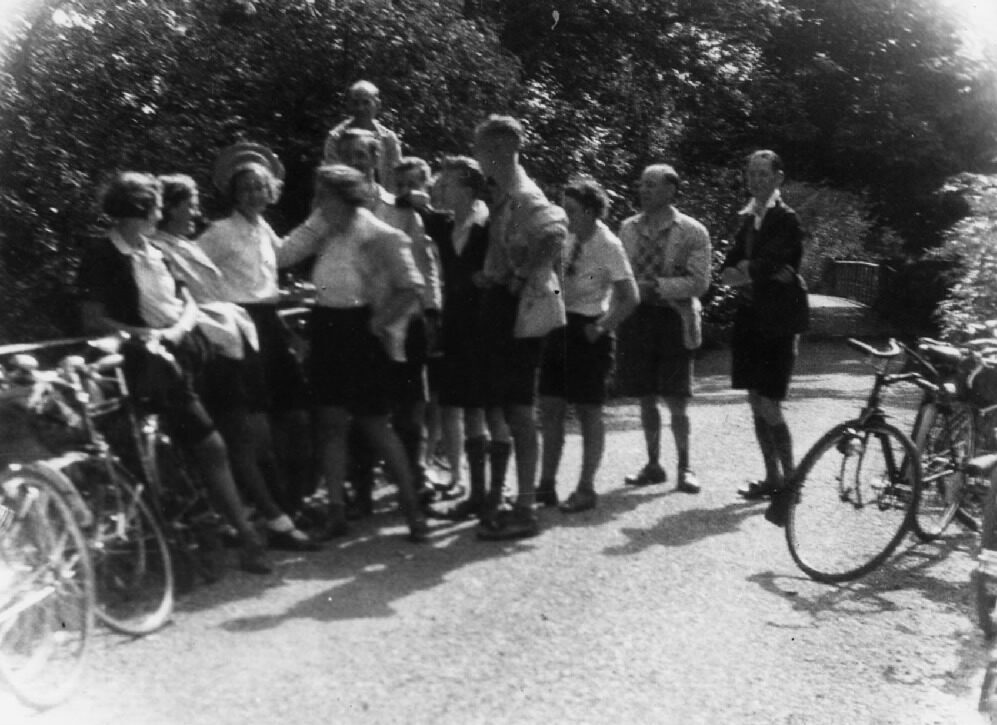
It was inevitable that the young men’s fancy turned not to love but to competing against the clock. The Club’s first 25 mile time trial was held on September 10th and it was won by Len Howell in 1hr 14 mins with G. Whitehouse at 1hr 17mins 5Osecs. and S. Goodwin at 1hr 18mins 50secs.
With this urge for speed came the formation of a hardriders section, and rides to the Cotswolds, 24 hour Bath and back and a round trip to Ely in the Fens were organised. Mention of ‘Fullers’ at Girtford Bridge for tea will bring back some happy memories.
In the first year of the Club a link was being formed by Freddie Dove who joined from the old Apsley Village Club Cycling Section. A treasured possession of mine is a medal from this Section won by my brother W. Hall for first ‘place in a 10 mile event in 1906. He was posted’ missing in the Great War during 1916.
And so the months of 1933 closed with the First Annual Dinner held at the Midland Hotel, Hemel Hempstead on Saturday December 9th. The five course meal with two bottles of port and a cabaret amounted to a grand total of £13.4.6d for 34 members.
Items in the first account book and minute book make remarkable reading. We purchased two whistles on April 8th, 1933. Cash turnover was £46.6.9d and our balance was £1.6.10d. Committee meeting May 6th 1933: Resolution passed that no shouting and more reserve be maintained when passing through towns - imagine that today.
1934 saw the introduction of the Club’s Best All Rounder competition instituted over 25, 50 and 100 miles and the first winner of the Attwood Shield was Len Howell with an aggregate speed of 21.025 mph. This was the world of black alpacas and racing tights, of dawn starts and riding out on Saturday to overnight accommodation. We talked of Chater-Lea hubs, Selbach, Claud Butler and Carpenter cycles the pride of every cyclist.
The records are in the history books of the Club, but all our riders were champions against the clock that always ticked faster than the downward thrust of the pedal.
1934 now also saw the first of many Easter tours to Wales and this covered the Black Mountains and Abergavenny where an excellent inn provided accommodation. The Captain and organiser was Sid Goodwin who at breakfast time would produce a Bart’s map and point to some very dark patches to be climbed during the day’s ride.

In the summer of the same year, Alderman H Fletcher, who was the President, invited all the Club to a picnic at Marlow.
The Club now had a very strong Racing section making their mark in an everwidening sphere of open time trials. J S Spackman, a 24 hour expert set an example for the longer events on the North Road and into the Fens.
The importance of the Clubroom had been recognised and ‘The Sun Inn’ just beyond the Town Hall, became our first regular home. Touring and racing photographs lined the walls and it was here that the very popular children’s parties were held and parents, hoping of course, that some of the goodies would be left for them afterwards.
In 1934 the Second Annual Dinner took place at the ‘Heath Park Hotel’ and the toast to the Club was proposed by Alderman Fletcher, coupling with it the name of Mr. S Goodwin, the Club Captain. The Club was being run on the right lines and it had a sound background of good officials.
The ladies were also very active on Club runs and many of the longer distance tourist trials. One very popular Club run was to Bedford and there always appeared to be more space on the river in those days. These were also the days of the tandem for mixed couples and they also offered good shelter if you kept close to the rear wheel.
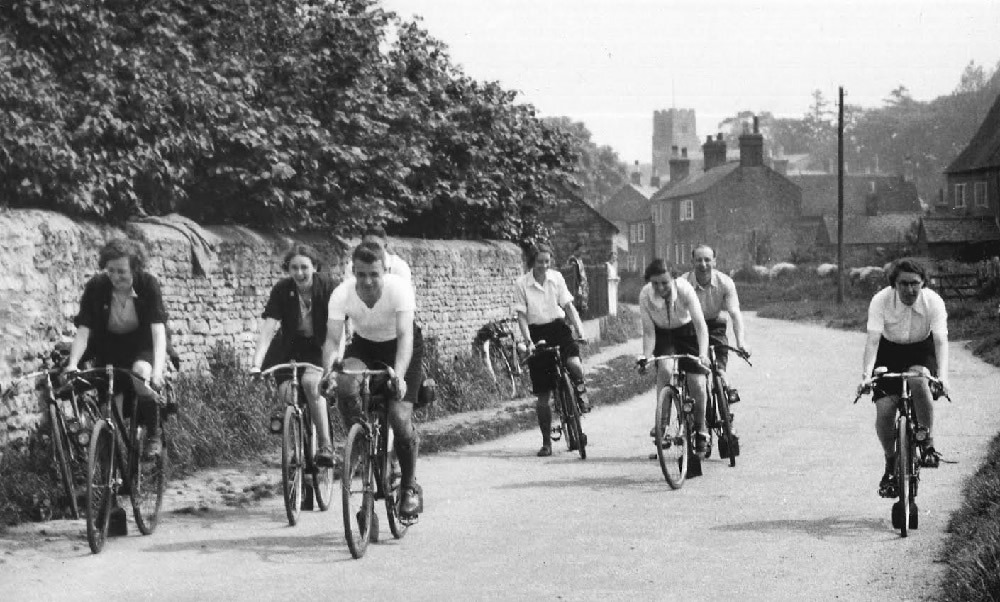
We know the old club tea places have disappeared but many will remember the association of certain special fare supplied, bananas at ‘The Cafe’ Loudwater, huge apple pies at ‘The Post Office’ Bow Brickhill, to Harpenden for sausage and mash followed by an enormous spotted dick which would be set on the table still in its cloth. Rabbit or pigeon pie at ‘The Old Cottage’ Westmill. The pub at Winkfield always came up with boiled eggs. Another favourite port of call for tea was ‘Baidens’ at Oxford which was followed by a hard and quick run to ‘The Dark Lantern Inn’ at Aylesbury for a game of darts. Jack and Bernard Lamb were the experts and this was the hardriders.
The eager turning of pedals to distant horizons was helped by the use of Youth Hostels and Whitsun of 1939 saw Sid Goodwin taking a group to the Cotswolds and Min Hall on a Leicestershire Tour. We were now, however, seeing our members going off to the Army or Red Cross training and into another chapter of the Club’s history. Distant horizons no longer meant wandering down leafy lanes looking for a C.T.C. sign of ‘Bed & Breakfast’. No more rice pudding stops on 12 hours or hearing the magic cry of ‘Man up’.
Epilogue: Written in 1982 in preparation for the Club's 50th Anniversary Dinner
I have been asked to write a tailpiece to the account of the club’s history that you have just read.
I will not repeat the cliché ‘that it seems like yesterday’ but, I can remember something of the club’ s first run in 1933.
The start was outside the ‘Waggon and Horses’ in the Marlowes. Where incidentally we held our first meeting in an upstairs room when the decision was taken to form the Hemel Hempstead and District Cycling Club. I cannot recall where our first lunchstop was, but it was in some woodland and I recall going round looking at rider’s machines. There had been a great deal of rain during the previous week and somewhere in the area of Whaddon chase we encountered a flooded lane and climbed the bank into a field to get round it, collecting a great deal of mud in the process. Harry Eyres then led us by a, to my mind, devious route, to Leighton Buzzard, where we stopped for tea at a cafe, long since gone, on the Billington Road.
Since then, there have been over 2500 runs, weekends and tours, apart from time trials, road races and social events.
Many members have come and gone but always programmes have been planned and carried out, during good times and bad.
Always there have been members willing to organise and take part. Without them, the club would be but a memory.
So to those who will take over in future years, I say carry on, we have given you a good start’
Cheerio,
Sid.
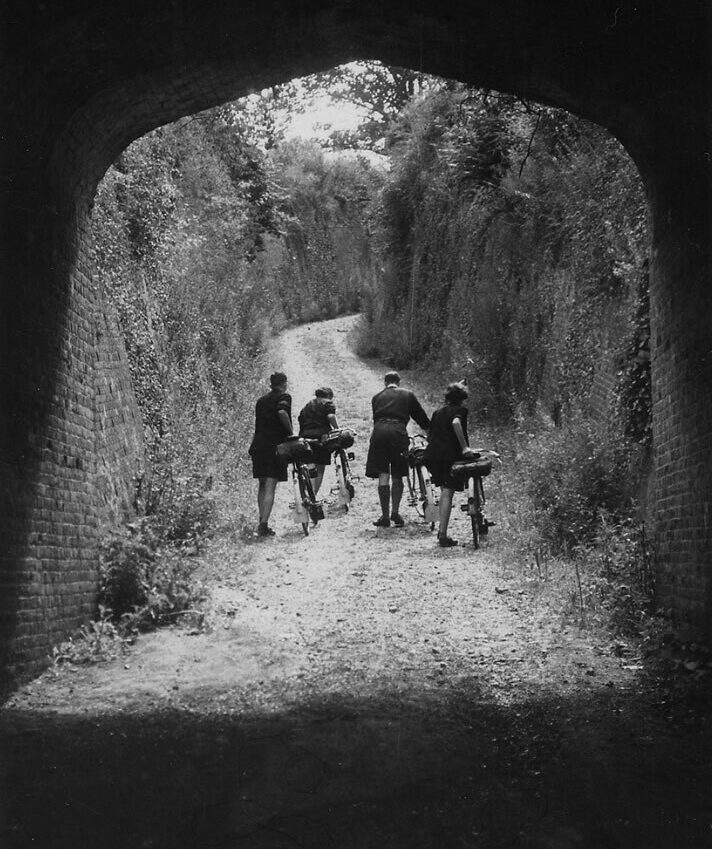
*Thanks to Dr Steven Bond for the photos. His parents-in-law Bill Barnes and Sylvia Pearman were keen members of the club in the 1930s and feature in the photos above.